Smart Libraries: AI Use in South Korea
 Artificial Intelligence is rapidly reshaping how information is created, accessed and delivered. For libraries, this new technology presents many opportunities as well as questions about how to best adopt and make use of it responsibly.
Making accessible books remains a costly, labor-intensive task, that a lot of libraries are trying to find way to optimize this work. AI can be a good opportunity for libraries to enhance their services, in a faster, less cost way, making the limited resources go further to deliver more to readers. Yet, a lot of libraries still have concerns and are understandably cautious about integrating AI into their services. In this article, we take a closer look at the transformative work of the South Korean National Library for the Disabled to enhance access to information to their patrons.
The National Library for the Disabled is a government institution serving persons with disabilities. It was established in 2007 as a center for people with disabilities, and later, in 2012, it was integrated as an affiliated institution of the National Library of Korea, and in 2020, it was elevated to the status of a national library, continuing to serve persons with disabilities.
National Library for the Disabled Services
The library provides a wide range of accessible materials to help persons with disabilities access resources more easily. These formats include DAISY format, braille, braille music, accessible EPUB, Korean sign language, easy-to-read materials, and braille-labeled books. In addition to their digital services, they also still provide mail delivery services for books and make materials available through local libraries.
To support access and circulation, the library operates three major platforms: the National Library for the Disabled website, the National Accessible Materials Sharing System (DREAM: Direct Rapid Easy Accessible Materials), and the sign language materials mobile application.
DREAM is a union catalogue and management system designed to share and manage materials among libraries across the country. Currently, this network has a total of 62 member institutions.
Using AI to Optimize Library Services
In addition to this robust library system, they have started implementing AI in their services.
To support publishers in creating born-accessible publications, they have developed an online verification system to assess the accessibility of their publications. This system combines EPUB accessibility tools, such as Ace and EPUBCheck, with an AI-powered Chatbot assistant. It is a quick verification system that detects errors and then the chatbot guides publishers with explanations and sample solutions. Through this system, publishers can learn about any issues in their publications, be guided through corrections, and ultimately ensure that accessibility features have been correctly implemented and independently verified before publication or adoption into the library. 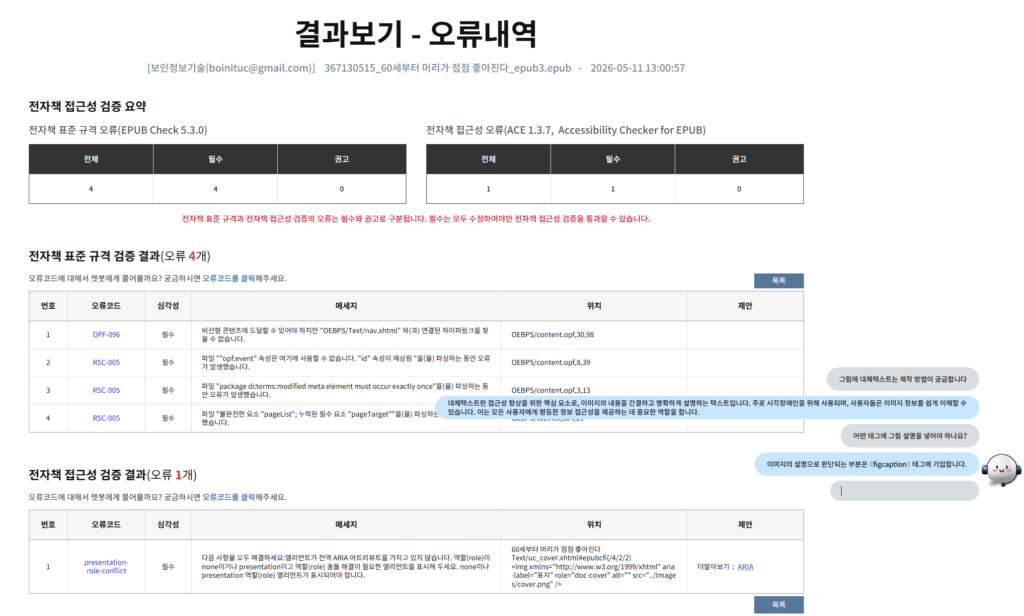
In the image above, the report displays results of both EPUB validation errors and accessibility issues detected in a sample file. The upper section summarizes the total number of issues found, separating critical errors from warnings. The detailed tables below list the error codes, severity level, location in the EPUB file, and technical descriptions of the issues.
In the lower right corner, the AI chatbot supports users by answering accessibility related questions in simple language, such as how to create alternative text for images and where to add these image descriptions. This guides publishers, builds a better understanding of accessibility requirements and supports the correction process.
The library is also testing a new system that automates the production of accessible formats. Using a generative AI production system, the goal is to increase the number of accessible books created each year, ultimately offering library patrons a significantly wider choice of publications in the accessible formats they prefer. The National Library for the Disabled have been very successful and pioneering in their use of AI to optimize and enhance their services, taking care to ensure that the technology is implemented with appropriate safeguards in place.
AI is not perfect, it can make mistakes and it needs to be used carefully, ideally with a human in the loop. But it does hold the potential to unlock and accelerate the creation of publications in accessible formats for people with print disabilities. Through information sharing within the DAISY community, we can continue to learn from each other and build on successful practices, helping us all to make the most from investments in AI technology.
The DAISY AI Special Interest Group is open to all DAISY Members, with a discussion list and monthly meetings with presentations on the latest developments in AI and the results of experiments within the group. Further details can be found on the AI Special Interest Group page.
This article was based on a presentation delivered at the IFLA International Symposium on Accessible Library and Information Services in Tokyo, Japan. Our thanks to Myungsook Kim of the National Library for the Disabled, Republic of Korea, for their contribution.