Dalia’s Journey: Improving Accessible Reading in Arabic
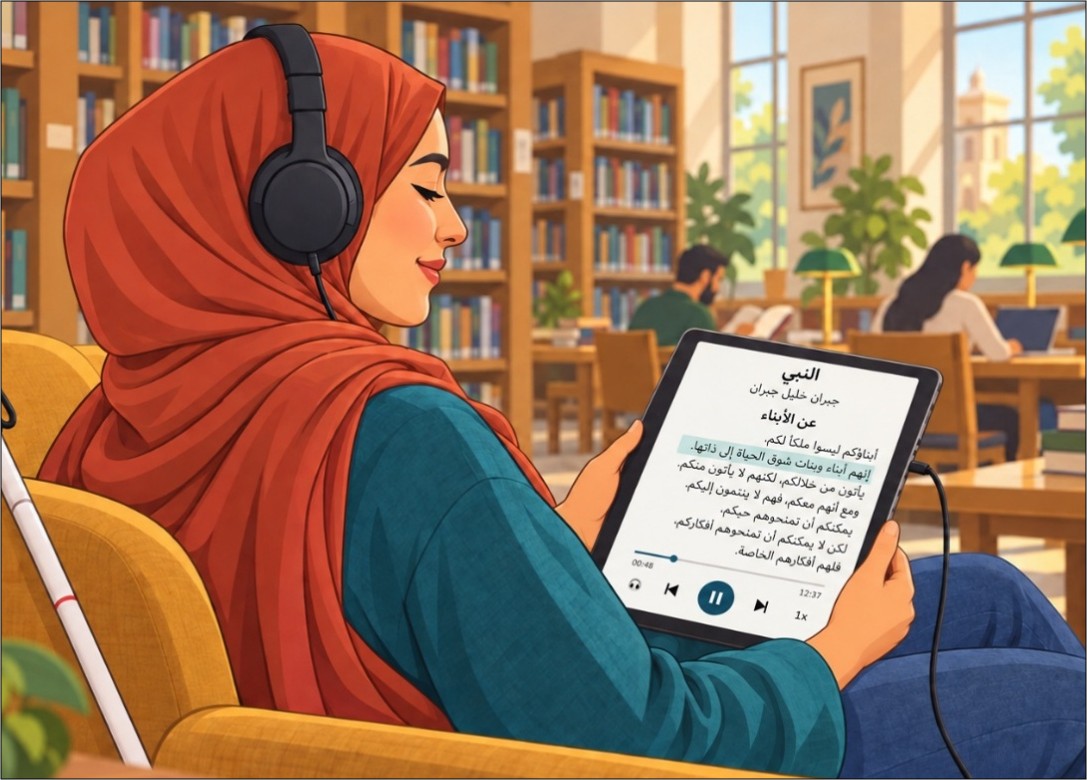
 Dalia was born and raised in a North African country. Blind from an early age, she attended a school for blind students, where she learnt in braille and quickly developed a love of reading.
When a book was not available in braille, her mother would read it aloud to her. Throughout her school years, Arabic textbooks were available in braille allowing her to study independently. However, entering university was a different experience.
Academic books in Arabic were rarely available in braille or any other accessible format. To study, she increasingly had to rely on the support of others. Friends and volunteers read books aloud or helped her access materials that her classmates could simply pick up from the university library.
The barrier was not her academic aptitude, it was her ability to obtain the books she needed, when she needed them, in a format she could read.
Years later, when she moved to a European city to start her master’s degree, studying in a language other than Arabic, she encountered a very different experience.
This time she was provided with assistive technology, including a screen reader and braille display, and had access to a library with an extensive digital collection. Instead of waiting for someone to read or convert a book, she could find much of the material available and read independently.
She could search for information herself. She could decide what to read and when to read it. She could move between sources, return to a passage, take notes and study at her own pace.
Dalia’s experience, which is surprisingly common, illustrates both how far accessible publishing has come and how uneven that progress remains. Her story also raises the question: what would it take for readers across the Arab region to enjoy the same independence when accessing Arabic language books?
Today, in countries with well-established accessible publishing ecosystems, access is still far from perfect, but obtaining an accessible title has become significantly easier. A blind person looking for a newly published book may be able to get an accessible version from a specialist library. Also, accessible publications can also be obtained directly through mainstream commercial routes thanks to publishers that make their digital books accessible from the outset, allowing readers with print disabilities to obtain them without having to wait for conversion. Gaps remain in the availability of accessible titles, and ongoing work to address this continues. Yet, these options offer a level of access that is much harder to find in Arabic content.
Despite Arabic being one of the most widely spoken languages in the world, support for accessible publishing and reading in Arabic is still not where it needs to be.
For someone looking for the same title in Arabic, the picture can be very different. The accessible version may not exist. It may take considerable time and effort to produce. Even when an accessible copy exists somewhere, the reader may not know where to find it or may not legally be permitted to access it. This is a significant contrast with more established services for finding and obtaining accessible titles in other parts of the world.
Although Arabic speaking countries share common challenges, experiences also vary across the Arab countries and between institutions, depending on the progress of Marrakesh Treaty implementation, technology and support available. Some institutions may have the resources and expertise to produce and deliver accessible books, while others still face gaps in funding, capacity building and access to suitable technology.
Addressing these gaps requires work at several levels: increasing availability of accessible Arabic content, help readers discover and obtain it easily, ensuring reading tools support the language and readers’ needs.
The DAISY Consortium has been working in conjunction with partner organizations to raise awareness of these challenges and implement mechanisms that directly address them. Efforts include DAISY training to build local skills in accessible book production, working directly with technology companies to improve support for Arabic, and through the Accessible Books Consortium (ABC) provide training, production and the encourage the exchange of accessible books.
Some progress has been made in the Arab region. DAISY has also delivered training through various projects and partnerships, including with ABC, reaching 6 of the 22 Arabic-speaking countries. More capacity building opportunities are available now such as the ABC capacity building programs, with some online training courses available in Arabic. The ABC Global Book Service has been slowly building the number of titles in Arabic, but it currently holds fewer than 300 Arabic language titles.
Until recently, there were limited reading systems localized to Arabic, this has started to change over time. DAISY have been working with partners including EDRLab and Dolphin to bring improvements in language support to their reading systems. As a result, Thorium and EasyReader now both offer an Arabic interface and improved support for Arabic titles.
Working with several of the big tech companies, DAISY has also provided feedback on AI technology and synthetic speech used to generate audio of Arabic voices.
The DAISY Arabic network has been established to bring together organizations serving persons with print disabilities to share expertise, exchange knowledge and advocate for the right to read. It provides a channel to connect efforts across the region, address shared challenges, and to collaborate on common objectives.
The goal is therefore not only to produce more accessible books. But to create an ecosystem in which a reader in Arabic speaking countries can expect the same experience that readers increasingly have elsewhere: to discover book, obtain it in an accessible format and read it independently without delay or without having to depend on others to make it accessible first. Priorities include expanding accessible Arabic collections, making existing titles easier to find and obtain, and improving access to suitable reading tools.
We are already seeing positive changes happening across the region, and as it continues to develop the challenge becomes one shared globally, to make that experience of reading an accessible book ordinary rather than exceptional.
Dalia’s journey highlights a very important issue and contrasts the user experience when independent access is restricted and when it is supported. The destination is clear, a world in which where you live, the language you speak and the accessible format you prefer does not determine which books are within your reach.
Thanks to all our partner organizations for assisting us in this work, with special thanks to ABC, CBM and GIZ. If your organization would like to support activity like this please contact us.
Related links: