

Accessible STEM using MathCAT
 Mathematics is everywhere, from school textbooks and university courses to science, engineering and everyday life. Yet for many blind and print-disabled people, accessing mathematical content remains unnecessarily difficult.
A major international initiative is now working to change that. The DAISY Consortium’s MathCAT Initiative is bringing together blindness organisations, accessible-format producers, mathematics specialists, developers, publishers, educators and technology companies to build on significant advances in MathCAT and help secure its long-term future.
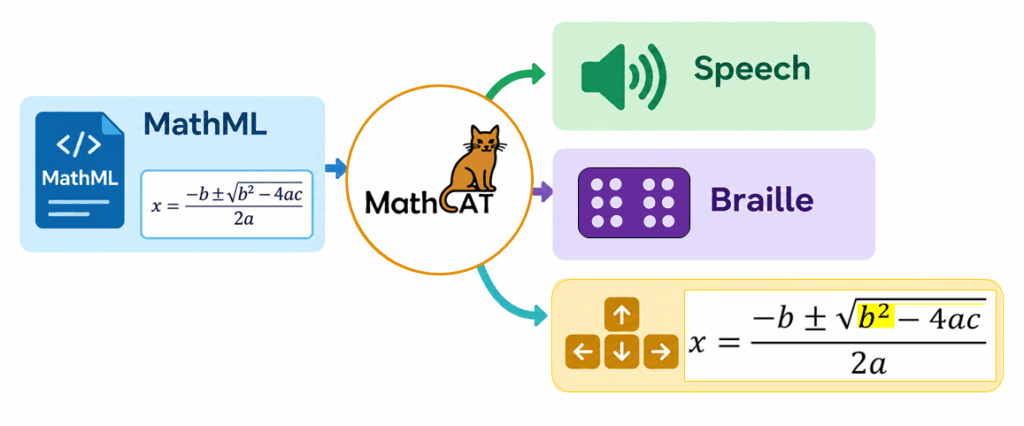
MathCAT – short for Math Capable Assistive Technology – is an open-source library that enables existing technologies to deliver mathematics (in MathML) in speech and braille, with navigation through mathematical expressions.
From Specialist Technology to Shared Infrastructure
Rather than requiring every technology developer to solve the complex problem of interpreting mathematics independently in their products, MathCAT provides a shared foundation that can be incorporated into screen readers, reading applications, production tools and other technologies.
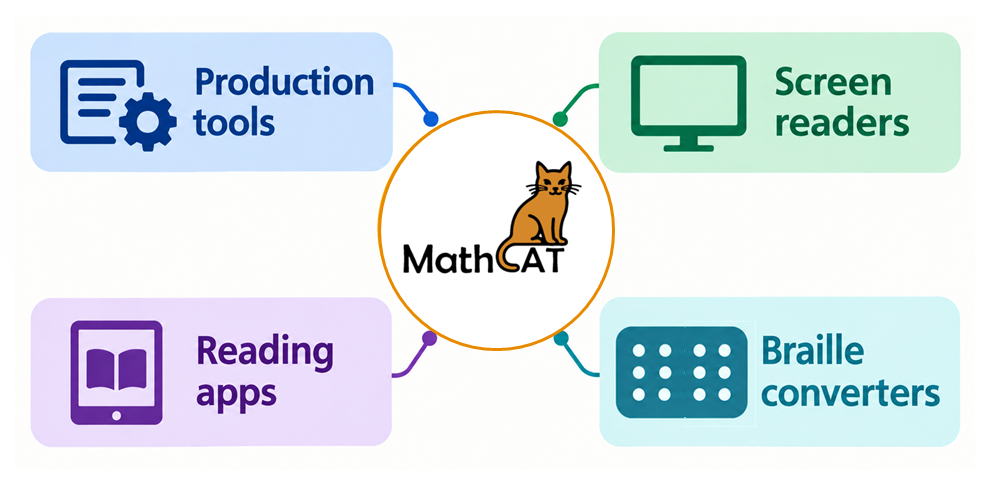
MathCAT has become an essential tool for both producers and end-users, and is now integrated into, or supported by:
- Reading tools: including Dolphin EasyReader App, EDRLab’s Thorium Reader, Kurzweil 3000
- Screenreaders: including JAWS, NVDA, Dolphin ScreenReader and Dolphin SuperNova, Orca
- Productivity tools: MS Word and MS PowerPoint
- Production and converter tools: including APH BrailleBlaster, DAISY Pipeline, Sao Mai Braille Converter, and Textalk Webarch. Agencies such as MTM in Sweden and the National Library of Norway integrate tools like these into their workflows, to produce books containing mathematical content in accessible text-to-speech and braille formats.
For publishers and accessible-format producers, this can make the complex task of creating mathematical content more manageable. For developers, it offers an opportunity to build on a shared, open technology rather than developing separate solutions.
The ambition is not simply to improve one screen reader or one production tool. It is to create technology that can be shared across the accessibility ecosystem. Hari Narayan, a specialist educator, emphasises this point:
I consider MathCAT particularly significant because it addresses a foundational accessibility problem rather than creating a solution limited to one textbook, one curriculum or one device.
The Importance of Accessible Mathematics
Importantly, MathCAT gives end-users a more consistent way of reading and exploring mathematics across their different technologies. Hari goes on to say:
In our experience, there is a remarkable difference between the experience of a blind student trying to access mathematics without MathCAT and the experience of the same student when mathematical expressions can be accessed through MathCAT.
Blind engineering student, Ashwin Rajesh, has described how MathCAT has supported his independence and confidence in studying mathematics and science:
MathCAT did not simply help me read mathematics. It gave me greater independence in learning mathematics and helped give me the confidence to continue with mathematics and science, prepare for engineering entrance examinations, and ultimately pursue engineering.
Supports Reading Needs of Users
MathCAT is designed with real users in mind. Its flexible and customizable settings allow speech, braille and navigation to be tailored to different situations and preferences, helping people access mathematical content in the way that works best for them.
Multi-Lingual Speech and Braille Output
MathCAT is also becoming increasingly international. It currently supports speech in 15 languages and nine braille codes, with further languages and codes under development. This reflects an important principle of the project: accessible mathematics needs to work for people using different languages, braille codes, technologies and educational environments.
Sustainability: the Next Challenge
The rapid growth of MathCAT also highlights a significant challenge. As more organisations begin relying on MathCAT, it has become increasingly important to ensure that the technology has a sustainable future, building on the good work undertaken so far.
The DAISY Consortium’s MathCAT Initiative addresses this challenge, to build a broader community around the technology and explore options for long-term stewardship and development.
The next chapter of MathCAT requires other developers to join the cause, with engagement and support from wider sector specialists.
An Invitation to Participate
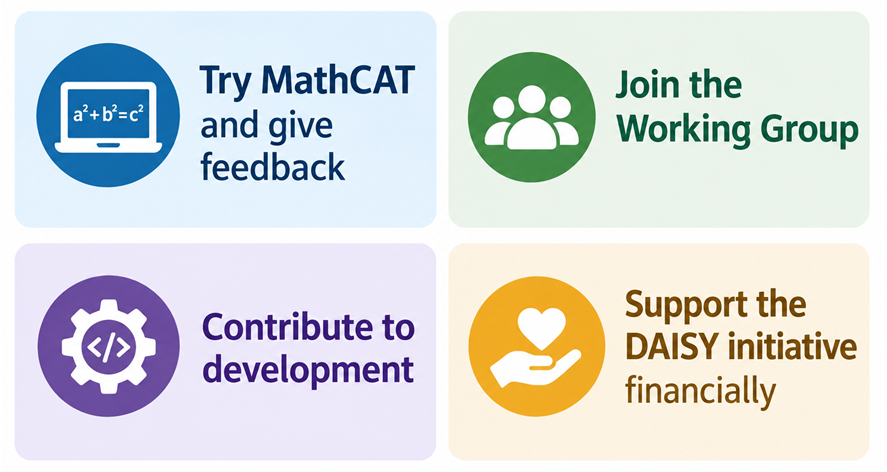
We invite blindness agencies, accessible-format producers and mathematics experts, publishers, developers and technology companies to join us in creating a sustainable future for MathCAT, by for example:
- Using MathCAT in existing tools in the real world, giving feedback and sharing requirements
- Developing and testing code
- Preparing translations and providing expertise for country-specific braille codes
- Exploring integration into production workflows and sharing requirements
- Financially supporting the DAISY MathCAT Initiative
“MathCAT has reached an important point in its development,” says Richard Orme, CEO of the DAISY Consortium. “The technology is making a real difference, but its future depends on building a community around it.”
Next Steps
For anyone involved in accessible publishing or assistive technology, this is an opportunity to help establish a tool which benefits the whole ecosystem – not just one product or organisation – we are stronger when we work together.
- Find out more and join the MathCAT community
- If you’d like to dive into the technical details right away, visit the MathCAT (technical) Project Page and the MathCAT GitHub Repo
- Share your experiences and needs in the DAISY Survey on Producing and Reading Accessible Mathematics Content 2026